The Production Design of 1.21 Gigawatts
For this video concept to succeed, we needed our audience to feel like our hero was really back in time in several iconic Hill Valley locations during different time periods. This required extensive research into the original trilogy’s production design & locations, identifying then acquiring matching props & decor, and creating replicas when the originals weren’t available any more.
Table of Contents
Marty’s Bedroom (1985)


For this interior shot, we used our own bedroom as the interior location. As the first impression and opening to our video, I knew I needed three key props to make this scene work: Marty’s alarm clock, the Diet Pepsi can, his Huey Lewis Sports poster. It turns out none of these items would be easy to acquire, so I had to find alternatives or make my own.
Marty’s clock in the original films was a Panasonic RC-6015, which is highly sought after by collectors. I was able to find a much more affordable and visually similar model clock, the Panasonic RC-6030.


The only 1985 screen-accurate Diet Pepsi Free can I could find was going for hundreds of dollars on eBay, so created my own: I recreated the can label in Photoshop, printed it on metallic silver inkjet sticker paper, wrapped it around a custom 3D printed cylinder, then cut the top off of a real can and glued it as a lid.
I was eventually able to identify the exact poster on Marty’s bedroom wall: it’s a Huey Lewis and the News “Sports” ‘83 US promo rock poster, no longer available for sale. I recreated a high-res version for printing in Photoshop using high res scans of the laserdisc cover and used the closest fonts I could find.
The rest of the final touches involved finding similar lamps, vintage patterned & textured bed dressings, and 80s style photographs, though I threw in a couple of Easter Eggs too: George McFly’s book (A Match Made in Space), a Polaroid photo of my parents and uncle from the 80s, my father’s 1967 Fender Stratocaster guitar in seafoam green, and my original Blockbuster Video membership card. All the cassettes are from Erik Deutscher’s personal collection, including one from Bluefire, his old band.


Doc’s House (1955)


I knew for this scene I needed four framed portraits of Doc’s favorite scientists over a fireplace, along with many antique decor touches such as Tiffany stained glass lamps and wood panel walls. For this interior location, we were fortunate to have a friend who loved BTTF and had a Craftman-style home that reminded us of Doc’s house in 1955 both in style and decor.
One of my favorite finds for this scene was figuring out that Doc’s dictation machine in BTTF 3 was a Grundig Stenorette S. By sheer luck I found the exact model and colorway in excellent condition for sale at a Goodwill here in Los Angeles, so you can see it in the final video on the table next to the courthouse model.
The small Hill Valley courthouse model was a last minute crazy idea and addition– the week of the scheduled shoot, we ran to the dollar store and grabbed a bunch of items to spray paint white. I was able to find a similar model car for cheap on Ebay with quick shipping, and created the car’s turn-key and electricity rod using a scrap wire and a pencil. After adding an old memo board as a base, some painted boxes, an analog watch, and some PVC pipes, we were literally finishing the final assembly on set while the camera team was still setting up.


The big hero prop/gag here is the shot where “Marty” pops up while wearing Doc’s second most famous invention– his Brain Wave Analyzer helmet. Erik and I built this helmet from scratch over several weeks, from creating a replica design from movie screengrabs and original concept art, to cutting acrylic rods and sheet metal to create all the components.
I also knew that I wanted to fill this scene with as many Easter Eggs as possible, both from the movie and from our own personal lives. Here’s a quick list:
- Marty’s letter to Doc in 1985
- Marty’s family photo, with all the faces swapped with the faces of No More Kings members
- Marty and Doc’s clock photo from 1885
- Marty’s video camcorder
- Marty’s school tardy slip from Mr. Strickland
- Custom-made Milk Bone dog biscuits box replica
- Doc’s napkin drawing of the Flux Capacitor
- Doc’s favorite book, 20k Leagues Under the Sea
- Childhood photos of Erik’s father and grandfather
- My grandfather’s triangular ruler
- My grandfather’s Kennedy Space Center launchpad photos from when he worked at NASA as an engineer on the Apollo program
- Vintage photos from Cuba from my family


Hill Valley (2015)


We couldn’t have a visit to 2015 without a gritty alley covered in future trash. A moment of silence for all the brave laserdiscs who gave up their lives to make this scene happen.
The real heroes of this scene are my amazing production design crew: Leigh Vandiver, Shawn Crosby, Mike Carey, and Claire Carey. We didn’t have the storage space or transportation available to create all the future trash in advance, so they assembled all the trash cubes on set and weathered all the posters before this scene’s afternoon shoot.


We had three styles of future trash cubes: Laserdiscs, paper, and “silicon”. Cardboard packing boxes were used as bases and then wrapped in black garbage bags or pink plastic table covers before adding in the extra details such as crinkle packing paper strips or laserdiscs.
One of the hero props for this scene required a replica of the Radio Shack Archer Space Patrol walkie talkies that Doc and Marty use in BTTF since the originals were not available. I designed a 3D model for 3D printing based on photos I could find online, utilizing a used a real antenna and power switch. For the back label, I recreated the design in Photoshop and printed it on the same metallic sticker paper that we used for the Diet Pepsi can.


Audition Hall (1985)


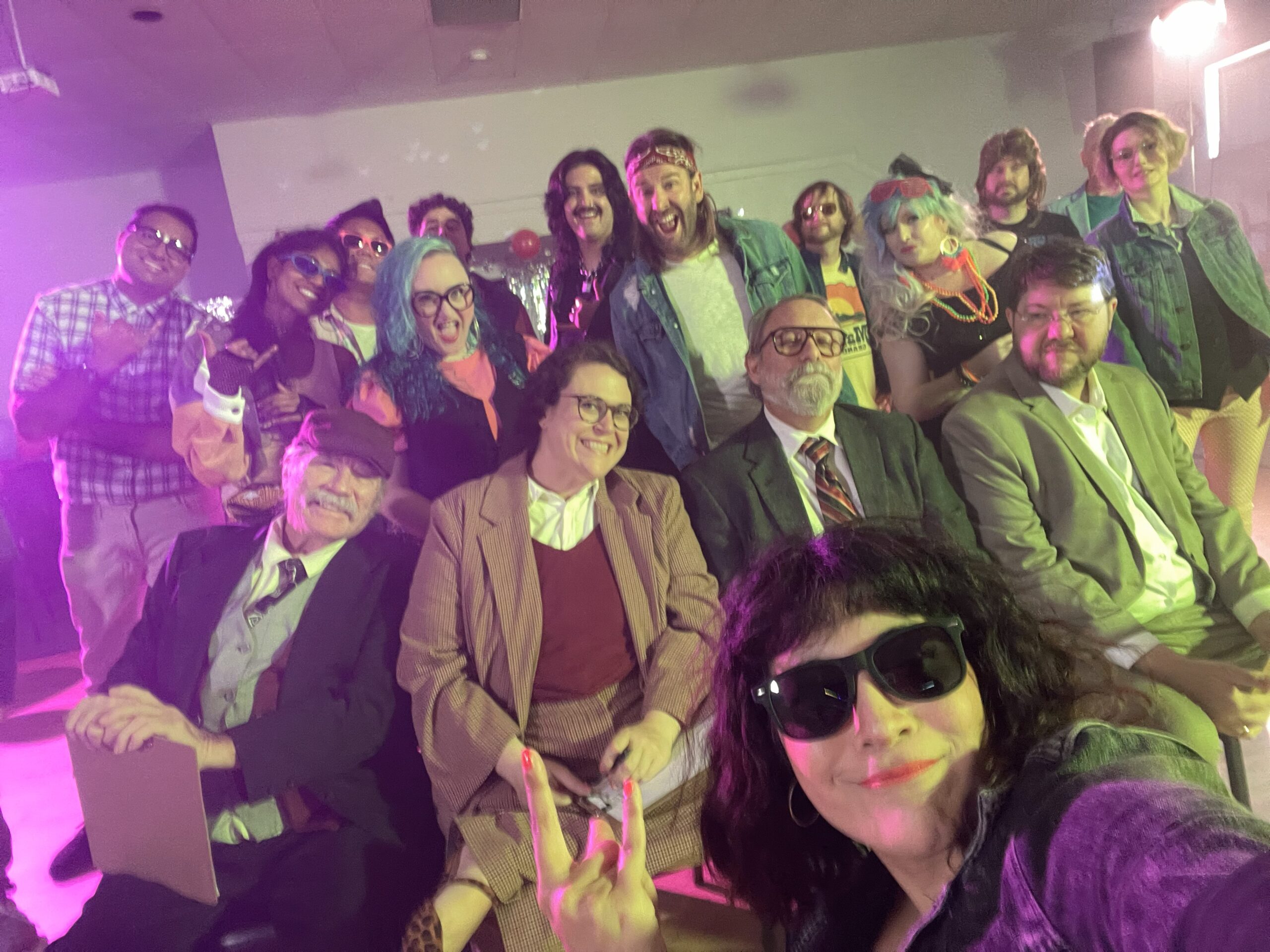
Our finale required the same set dressed for two different timelines: The alternate timeline where Marty’s band needed to audition again for Battle of the Bands, and the corrected timeline where they’ve already won and are hosting a concert instead.
For the audition scenes, we tried to keep the set as utilitarian as possible to feel like a boring school gymnasium. Plain banquet chairs, dollar store clipboards, and a cheap white & red megaphone helped round out the feeling of the scene. I recreated the design of the original audition banner in Illustrator by digitally hand-drawing the lettering. I couldn’t find any clear images showing the characters on the banner, so I drew my own to the best of my ability to match the general form of the blurry original.
My co-director Erik is a former musician, so he was tasked with finding the right music gear. We were incredibly lucky that our friend and professional musician, Tad Piecka, had everything we needed available to borrow. After we setup for the shoot, we realized we urgently needed an drum head cover to hide all the blankets in the drum kick. I cut a circle out of a garbage bag and taped it to the drum kit. One Sharpie drawing from Erik later, and we had a great garage-band style cover that would work on camera. Problem solved!


For the concert, I wanted it to feel like a regular school dance put on by students, with a little style of the Enchantment Under the Sea dance mixed in. The back wall and floor of the venue was decorated with basic party decor supplies such as garlands, streamers, and balloons. The stage backdrop was covered with tinsel blue and silver curtains, and the audition banner was replaced with a custom No More Kings banner in the same style as the Enchantment Under the Sea banner, with the king mascot drawn by the band’s lead singer (Pete Mitchell) himself.